
The Case for Mono Repos in the Age of LLMs
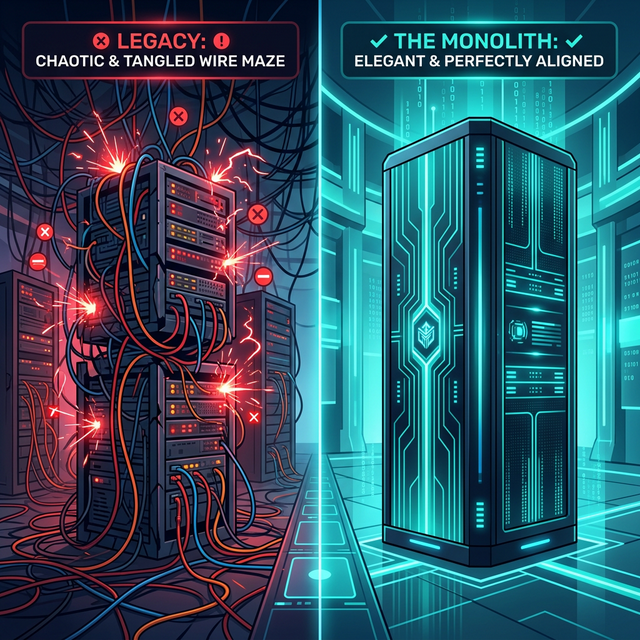
In a previous post, we discussed Reorganizing Workflows for LLMs: Modular Projects, LLM-Friendly Docs, and Test Guardrails. We talked about how adapting our processes to AI workflows fundamentally changed our productivity.
But there's another missing puzzle piece we discovered along the way: mono repos are the fastest way that you could organize your codebase.
The Problem with Distributed Repositories
Context Loss: When a project is split across multiple repositories—like having the backend, frontend, mobile app, and shared libraries scattered—context becomes incredibly hard to maintain.
Fragmented Truth: You end up having to piece together how an API change affects the client, or hunting down the source of truth for a shared type.
This is a problem for humans, but it's an even bigger problem for LLMs.
The Multi-Repo Struggle
- Frontend"Update the login form to require a phone number."
- AIGenerates the UI code but guesses the backend API endpoint.
- BackendThe backend repository expects a completely different payload shape.
- ResultYou spend an hour copy-pastin g API definitions back and forth.
The Mono-Repo Advantage
- Context"Update the login form to require a phone number across the stack."
- AIReads the shared TypeScript definitions and the backend API controller.
- ExecutionSimultaneously updates the frontend UI, shared types, and backend validation.
- ResultA single commit that runs perfectly end-to-end.
Context is King for AI
Unified Context: An LLM is only as good as the context you can provide it. When your entire system is unified within a single monorepo, providing that context becomes trivial.
Comprehensive Visibility: You don't need to link multiple repositories or manually explain how they connect. The AI can see the backend models, the shared interfaces, and the frontend integrations all at once.
Scenario: Refactoring a Core Type
Imagine renaming a field like userId to accountId. In a multi-repo world, you rely on the LLM to write a script or you manually copy instructions into separate chats for your web app, mobile repo, and API server. In a monorepo, you write one prompt: "Rename this field across the entire codebase." The AI instantly maps the blast radius because it all lives together.
Simpler for New Joiners, Simpler for LLMs
This time around, we unified our codebase. By bringing everything into a mono repo, we found that it's vastly simpler for new team members to understand the whole picture.
Grep Entire System
Search through the entire system with one command, instantly finding references across all apps.
Trace Requests
Trace a request from the UI, through the API, and all the way down to the database schema.
Test Vertical Slices
Test full vertical slices locally without needing to spin up disparate services from different repos.
And the exact same benefits apply to LLMs. Because the AI can instantly analyze the full project structure and the relationships between modules, its ability to generate correct, holistic code—without guessing about external dependencies—skyrockets.
Conclusion
If you want to move fast, reduce friction, and maximize the utility of AI coding assistants, put everything in one place. A mono repo isn't just an architectural choice; in the age of LLMs, it's a productivity multiplier.