
How LLMs Transform Product Ideation: From Concept to Demo in Hours
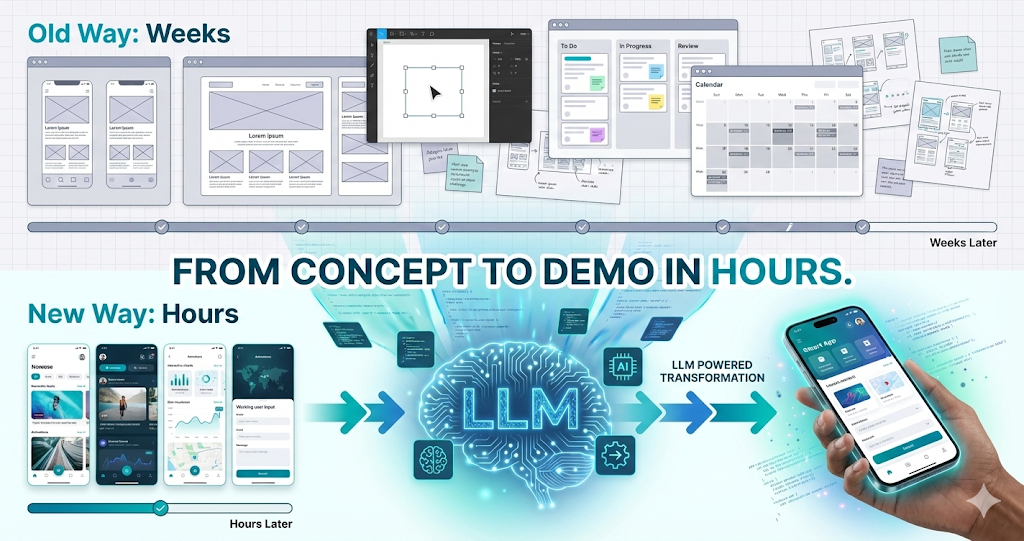
Product ideation used to be slow. You’d sketch an idea, build a mockup, wait for feedback, iterate on designs, then finally start development — only to discover the concept didn’t work in practice. By the time you had something demoable, weeks or months had passed, and you’d invested significant time in an idea that might not even be right.
LLMs change everything. Now you can go from “what if we built X?” to a partially working prototype in hours, not weeks. You can demo real functionality to management, not just mockups. You can explore multiple alternatives rapidly, test concepts before committing to full development, and get feedback on actual working code, not just designs.
The biggest shift isn’t that LLMs write code faster — it’s that they let you explore ideas faster. You can test concepts, iterate on alternatives, and validate assumptions before investing in production-quality development.
The Old Way: Slow Iteration Cycles
Before LLMs, product ideation followed a predictable, slow pattern:
Sketch and Design
You'd sketch wireframes, create mockups in Figma or Sketch, design user flows. This took days or weeks, depending on complexity. But mockups are static — they don't show how things actually work.
- Create wireframes and visual mockups
- Design user flows and interactions
- Days or weeks of design iteration
- Static images that can't show real behavior
Stakeholder Review
You'd present mockups to stakeholders, get feedback, iterate on designs. But feedback on mockups is limited — people can't really evaluate usability, flow, or feasibility from static images.
- Present mockups to stakeholders for review
- Feedback limited to visual impressions
- Can't evaluate real usability or flow
- Multiple rounds of design revision
Development Planning
Once designs were approved, you'd plan development: break down tasks, estimate timelines, identify technical constraints. This planning phase often revealed issues that should have been caught earlier.
- Break down tasks and estimate timelines
- Identify technical constraints late in process
- Planning reveals issues missed in design
- Additional delays before any code is written
Build and Discover Problems
You'd start building, only to discover the concept doesn't work as expected, or the implementation is harder than anticipated, or the user flow feels wrong in practice. But you'd already invested weeks in design and planning.
- Concept doesn't work as expected in practice
- Implementation harder than anticipated
- User flow feels wrong when actually built
- Weeks of design and planning already invested
Long Feedback Cycles
Each iteration required going back to design, updating mockups, getting approval, then implementing changes. Weeks between iterations. Months before you had something truly demoable.
- Go back to design for each iteration
- Update mockups and get re-approval
- Weeks between iteration cycles
- Months before anything is truly demoable
The fundamental problem: you couldn’t test ideas quickly. Mockups don’t reveal usability issues, technical constraints, or whether the concept actually works. You had to commit to development before you knew if the idea was sound.
The New Way: Rapid Prototyping with LLMs
LLMs change the entire ideation process. Now you can go from concept to working prototype in hours:
From Idea to Code in Hours
You describe your idea to an LLM, and it generates working code. Not production-ready code, but functional enough to test the concept. You can have a basic prototype running the same day you think of the idea.
Real Functionality, Not Mockups
Instead of showing stakeholders static mockups, you can demo actual working features. They can click buttons, see data flow, experience the user journey. Feedback is based on real interaction, not imagined usage.
Test Concepts Before Committing
You can build multiple variations quickly, test different approaches, explore alternatives. If one concept doesn’t work, you pivot to another without losing weeks of design work.
Discover Technical Constraints Early
When you build a prototype, you immediately discover what’s hard, what’s easy, and what’s impossible. Technical constraints become apparent before you invest in production development.
Iterate Rapidly
Feedback cycles shrink from weeks to hours. Stakeholder says “what if we changed X?” You can implement the change and show them a new version the same day. Rapid iteration becomes possible.
The Speed Difference
Here’s a concrete example of how different the process is:
Feature: Task Management Dashboard
Old Way
- •Day 1-3: Sketch wireframes
- •Day 4-7: Create Figma mockups
- •Day 8-10: Stakeholder review
- •Day 11-14: Iterate on designs
- •Day 15-20: Development planning
- •Day 21-35: Build prototype
- •Total: 3-5 weeks before demoable prototype
New Way (with LLMs)
- •Hour 1: Describe idea to LLM
- •Hour 2-4: Generate and refine code
- •Hour 5: Test prototype locally
- •Hour 6: Demo to stakeholders
- •Same day: Iterate based on feedback
- •Total: Same day to demoable prototype
The difference isn’t just speed — it’s the ability to explore ideas without committing weeks of work. You can test five different concepts in the time it used to take to design one.
Demoing Partially Working Apps to Management
One of the most powerful changes: you can now demo partially working apps to management. Not polished, production-ready software, but functional enough to show the concept:
Real Interactions
Management can actually use the prototype. They can click buttons, see data update, experience the flow. This is infinitely more compelling than showing mockups or describing concepts.
Honest Feedback
When people interact with real functionality, their feedback is more honest and actionable. They can say “this feels clunky” or “I expected X to happen” based on actual experience, not imagined usage.
Early Validation
You can validate concepts before investing in production development. If management doesn’t see value in the prototype, you’ve only lost hours, not weeks. If they love it, you have confidence to proceed.
Faster Decisions
Management can make decisions based on working prototypes, not promises or mockups. This speeds up the entire product development process. Ideas get validated or rejected quickly.
The best part? You can say “here’s what I built this morning” and show them something that actually works. That level of speed and capability changes how product ideation works.
Rapidly Formulating Alternatives
In the old days, exploring alternatives meant starting over. New mockups, new designs, new planning. With LLMs, you can explore multiple approaches quickly:
Build Multiple Variations
Instead of committing to one approach, you can build three or four variations in parallel. Test different UI patterns, different flows, different feature sets. See which one feels right before committing.
A/B Test Concepts
You can create two versions of a feature and demo both to stakeholders. “Here’s approach A, here’s approach B — which feels better?” This kind of rapid comparison wasn’t feasible before.
Pivot Without Losing Work
If one concept doesn’t work, you can pivot to another quickly. The code from the first attempt often informs the second. You’re not throwing away weeks of work — you’re iterating on hours of exploration.
Explore Edge Cases Early
When you build a prototype, you immediately encounter edge cases and questions. “What happens if the user does X?” You can explore these scenarios quickly, not discover them weeks into development.
The ability to explore alternatives rapidly means you’re more likely to find the right solution. You can test ideas, discard what doesn’t work, and iterate toward something better — all in days, not months.
Real Example: Exploring a Feature Concept
Here’s how this played out recently when exploring a new feature concept:
Feature Exploration: Smart Task Suggestions
Morning: Initial Idea
“What if we suggested tasks to users based on their patterns?” Started with a simple concept: analyze user behavior, suggest recurring tasks.
Hour 1-2: First Prototype
Built a basic prototype with LLM assistance: simple pattern detection, task suggestion UI, basic interaction. Tested locally — concept felt promising but UI was clunky.
Hour 3: Alternative Approach
Tried a different UI pattern: instead of popup suggestions, what if suggestions appeared inline? Built second variation quickly. Compared both — inline felt better.
Hour 4: Demo to Management
Demoed the inline suggestion approach. Management could actually use it, see how it worked, experience the flow. Got immediate feedback: “Love the concept, but can we make suggestions less intrusive?”
Hour 5: Iteration
Adjusted the UI to be less intrusive: suggestions appear subtly, can be dismissed easily. Updated prototype, demoed again same day. Management approved concept for production development.
Result: From idea to approved concept in one day. Production development started with confidence, not uncertainty.
In the old process, this would have taken weeks: design mockups, get approval, plan development, build prototype, discover issues, iterate. With LLMs, we went from idea to approved concept in hours.
Key Benefits
Speed
Hours instead of weeks. Same-day iteration cycles. Rapid exploration of alternatives.
Validation
Test concepts before committing. Real functionality, not mockups. Early discovery of constraints.
Risk Reduction
Low investment in exploration. Pivot without losing weeks. Validate before production build.
Better Decisions
Feedback based on real usage. Compare multiple approaches. Faster stakeholder decisions.
Understanding the Limitations
It’s important to understand what LLM-generated prototypes are and aren’t:
Prototypes, Not Production Code
LLM-generated code is great for prototyping, but it’s not production-ready. You still need proper architecture, error handling, testing, security, performance optimization. The prototype proves the concept; production development builds it right.
Exploration, Not Replacement
LLMs help you explore ideas quickly, but they don’t replace product thinking, user research, or design expertise. They’re a tool for rapid iteration, not a substitute for understanding users and solving real problems.
Requires Technical Knowledge
To effectively use LLMs for prototyping, you need technical knowledge. You need to understand code, debug issues, integrate components, deploy prototypes. LLMs amplify your capabilities, but they don’t eliminate the need for technical skills.
The Constant: Speed of Exploration
Every advantage of LLM-powered ideation stems from one shift: you can explore ideas in hours, not weeks. When exploration is fast and cheap, you test more concepts, get feedback on real functionality, validate before committing, and find better solutions. The speed doesn’t just save time — it fundamentally changes how product decisions are made.
What This Means for Product Development
The shift from slow ideation cycles to rapid prototyping changes how product development works:
More Ideas Explored
When exploring ideas is fast and cheap, you can explore more of them. Instead of committing to one concept and hoping it’s right, you can test multiple ideas and pick the best one.
Better Ideas Selected
When you can demo real functionality, you make better decisions. You select ideas based on how they actually work, not how they look in mockups. This leads to better products.
Faster Time to Market
When ideation is fast, the entire product development cycle speeds up. You spend less time exploring dead ends, more time building what works. Time to market improves.
Lower Risk
When you can validate concepts before committing to production development, you reduce risk. You discover problems early, when they’re cheap to fix. You avoid investing in ideas that don’t work.
Conclusion
LLMs transform product ideation by making rapid prototyping possible. You can go from idea to demoable prototype in hours, not weeks. You can test concepts before committing to production development. You can explore alternatives quickly, get feedback on real functionality, and iterate rapidly.
This changes everything. Product ideation becomes faster, less risky, and more effective. You spend less time on ideas that don’t work, more time building what does. You make better decisions because you can test concepts, not just imagine them.
The old way — slow mockup cycles, long feedback loops, committing before testing — feels archaic now. Why spend weeks designing something you can build and test in hours? Why get feedback on mockups when you can demo real functionality?
The biggest shift isn’t that LLMs write code faster. It’s that they let you explore ideas faster. And when you can explore ideas quickly, you find better solutions, make better decisions, and build better products.
If you’re still doing product ideation the old way — mockups, long cycles, committing before testing — try rapid prototyping with LLMs. You might be surprised how much faster and more effective product development becomes when you can test ideas quickly.