
Solutioning and Product Conceptualization With LLMs: The Architect's Role
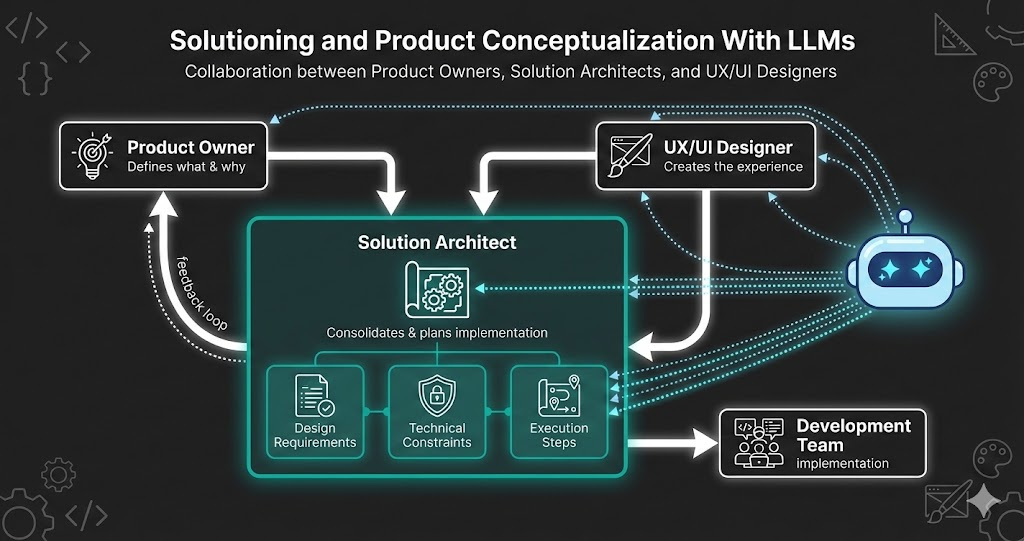
Product conceptualization isn’t a solo act — it’s a collaboration between product owners, solution architects, and UX/UI designers. Each brings unique expertise, but someone needs to drive the implementation planning. At Life Butler, that someone is the solution architect.
The architect doesn’t just translate requirements into code — they consolidate design requirements, technical constraints, and execution steps into a cohesive implementation plan. And with LLMs, this process is faster, more thorough, and more collaborative than ever.
The architect is the bridge between vision and reality. They don’t just translate requirements into code — they consolidate design, constraints, and execution into a plan that developers can actually follow.
Here’s how we structure solutioning and product conceptualization, with the architect as the primary driver of implementation planning.
The Three-Person Collaboration
Product Owner: The Vision
Defines what needs to be built, why it matters, and what success looks like.
- •Articulates business requirements and user needs
- •Defines success metrics and acceptance criteria
- •Prioritizes features and user stories
- •Provides context about users, market, and business goals
- •Works with LLM to explore use cases and edge cases
UX/UI Designer: The Experience
Designs how users will interact with the product and what it will look like.
- •Creates user flows and interaction designs
- •Designs visual interfaces and components
- •Defines design system requirements
- •Considers accessibility and usability
- •Uses LLM to explore design patterns and alternatives
Solution Architect: The Implementation Driver
Consolidates everything into an executable plan, driving the implementation planning side.
- •Consolidates design requirements from UX/UI
- •Identifies and documents technical constraints
- •Recommends execution steps and architecture
- •Creates implementation roadmap and technical spec
- •Uses LLM extensively to explore solutions and validate approaches
The Architect as Implementation Driver
The solution architect is the bridge between vision and execution. While the product owner defines what and the designer defines how it looks, the architect defines how it works — and drives the planning that makes it all come together.
What the Architect Consolidates
Design Requirements
Takes UX/UI designs and extracts technical requirements: component specifications, interaction patterns, responsive breakpoints, animation requirements, accessibility needs. The architect translates visual designs into implementable technical specs.
Technical Constraints
Identifies platform limitations, performance requirements, scalability needs, security constraints, integration requirements, and technology stack considerations. Ensures the solution is feasible within technical boundaries.
Execution Steps Recommendation
Breaks down the implementation into logical steps: what to build first, dependencies between components, integration points, testing strategy, deployment approach. Creates the roadmap that developers will follow.
How LLMs Support the Architect
LLMs amplify the architect’s ability to consolidate, analyze, and plan. Here’s how we use them throughout the solutioning process:
Consolidating Design Requirements
Extract Technical Specs from Designs
Architect shares UX/UI designs with the LLM and asks: “What technical requirements does this design imply?” The LLM identifies components, states, interactions, and technical considerations.
Identify Implementation Patterns
LLM suggests implementation patterns: “This design pattern typically uses X component architecture” or “This interaction requires Y state management approach.”
Structure Requirements Document
Architect uses LLM to organize requirements into structured documents: component specs, API requirements, data models, state management needs.
Analyzing Technical Constraints
Constraint Identification
LLM identifies platform limits, performance considerations, scalability challenges, security requirements, and integration constraints.
Trade-off Analysis
LLM analyzes trade-offs: “If we use approach X, we get Y benefit but face Z constraint.” Informed architecture decisions.
Risk Assessment
LLM identifies risks: performance at scale, security concerns, integration pitfalls. Architect addresses these proactively.
Recommending Execution Steps
The architect uses LLMs to break down implementation into logical, executable steps:
Dependency Analysis
Architect describes the feature to the LLM and asks: “What should be built first? What are the dependencies?” LLM identifies prerequisite components and logical build order.
Implementation Roadmap
LLM helps create a step-by-step roadmap: “Step 1: Build data model. Step 2: Create API endpoints. Step 3: Implement UI components.” Architect refines and validates.
Integration Planning
LLM identifies integration points: “This feature needs to integrate with X service at step Y.” Architect plans integration strategy and timing.
Testing Strategy
LLM suggests testing approach: “Test data model first, then API endpoints, then UI integration.” Architect incorporates into execution plan.
The Collaborative Workflow
Here’s how the three roles work together, with the architect driving implementation planning:
Product Owner Defines Requirements
Product owner articulates what needs to be built, why, and success criteria. Uses LLM to explore use cases and edge cases. Shares requirements with architect and designer.
UX/UI Designer Creates Designs
Designer creates user flows, wireframes, and visual designs. Uses LLM to explore design patterns and alternatives. Shares designs with architect and product owner.
Architect Consolidates and Plans
Architect drives implementation planning: Consolidates design requirements from UX/UI, identifies technical constraints, recommends execution steps. Uses LLM extensively to explore solutions, validate approaches, and create implementation roadmap.
Collaborative Refinement
All three roles review the architect’s implementation plan. LLM helps facilitate discussions, answer questions, and explore alternatives. Plan is refined based on feedback. Final technical spec is approved.
Architect Shares Plan with Development Team
Architect drops the implementation plan to developers: Developers review the technical spec, identify additional constraints, and provide feedback. Architect uses LLM to analyze feedback, adjust the plan, and relay constraints back to product owner and designer — creating a feedback loop that refines both plan and product design.
The Constant: LLMs Across All Roles
Every person in this workflow has an LLM at their side. The product owner uses it to explore use cases and edge cases. The designer uses it to discover patterns and generate alternatives. The architect uses it most intensively — to consolidate, analyze trade-offs, identify constraints, and build execution roadmaps. The LLM doesn’t replace any of these roles. It amplifies each one.
The Developer Feedback Loop
Once the architect creates the implementation plan, it doesn’t exist in isolation. The architect shares it with the development team, and developers identify constraints and challenges that weren’t apparent during planning. This feedback loop is crucial — and the architect is the bridge that relays it back to the product design team.
The Process
Architect Shares Plan with Developers
Architect presents the technical spec and implementation roadmap to the development team. Developers review the plan, ask questions, and start thinking about implementation details.
Developers Identify Constraints
As developers dig into implementation, they discover constraints: “This API doesn’t support that feature” or “This approach will take 3x longer than estimated” or “We need to refactor X before we can build Y.” They share these findings with the architect.
Architect Adjusts Plan with LLM Support
Architect uses LLM to analyze developer feedback: “Given these constraints, what are alternative approaches?” or “How can we adjust the execution steps?” LLM helps explore solutions and refine the plan. Architect updates the implementation roadmap.
Architect Relays Constraints Back to Design Team
Architect communicates constraints to product owner and designer: “We can’t do X as designed, but we can do Y instead” or “This feature will take longer because of Z constraint.” Uses LLM to help articulate trade-offs and alternatives clearly.
Iterative Refinement
Product owner and designer adjust requirements or designs based on constraints. Architect updates the plan. Developers continue implementation. This feedback loop continues throughout development, ensuring alignment between vision, design, and implementation.
Developers are closest to the implementation reality. By creating a feedback loop through the architect, their constraints inform both the technical plan and the product design — preventing wasted work before it starts.
Real Example: Building a Feature
Let’s walk through how this works in practice:
Feature: User Payment Flow
Product Owner Input
“Users need to pay for subscriptions. Must support credit cards and digital wallets. Need to handle failures gracefully. Success metric: 95% completion rate.”
UX/UI Designer Input
Designs payment form with card input, wallet buttons, loading states, error messages, and success confirmation. Includes accessibility considerations and mobile-responsive layout.
Architect Consolidation (with LLM)
Design Requirements: LLM extracts: payment form component, card input validation, wallet button components, loading states, error handling UI, success confirmation screen, responsive breakpoints, accessibility requirements.
Technical Constraints: LLM identifies: Stripe API integration, PCI compliance requirements, rate limiting needs, webhook handling, mobile payment SDK requirements, error handling strategy.
Execution Steps: LLM recommends: 1) Set up Stripe integration, 2) Build payment API endpoints, 3) Create payment form component, 4) Implement wallet buttons, 5) Add error handling, 6) Test payment flow, 7) Deploy with monitoring.
Architect refines LLM output, creates technical spec, and drives implementation planning.
Developer Feedback
Developers review plan and identify: “Stripe’s mobile SDK requires additional setup that wasn’t accounted for” and “The error handling approach needs refactoring of our existing error system, adding 2 days to timeline.”
Architect Adjusts and Relays Back
Architect uses LLM to explore alternatives: “Can we use a different approach for mobile payments?” LLM suggests alternatives. Architect adjusts execution steps and timeline. Relays constraints to product owner: “Mobile wallet integration needs extra setup, adding 2 days. We can either delay launch or simplify mobile wallet support initially.”
Product owner decides to simplify mobile wallet support for initial launch. Designer adjusts designs accordingly. Architect updates technical spec. Developers proceed with adjusted plan.
Key Principles
Architect Drives Implementation Planning
The architect is the primary driver of the implementation planning side. They consolidate inputs from product owner and designer, and create the executable plan.
LLM Amplifies Architect's Capabilities
LLMs help architects consolidate requirements faster, identify constraints more thoroughly, and recommend execution steps more systematically. The architect uses LLM as a thinking partner, not a replacement.
Collaboration, Not Isolation
All three roles work together. Product owner and designer provide inputs. Architect consolidates and plans. LLM facilitates the process but doesn’t replace human judgment.
Consolidation Creates Clarity
By consolidating design requirements, technical constraints, and execution steps, the architect creates a single source of truth that developers can follow. This reduces ambiguity and speeds implementation.
LLM Supports All Roles
While the architect uses LLM most extensively, product owners and designers also use LLMs to explore use cases, design patterns, and alternatives. Everyone benefits from AI assistance.
Feedback Loop Through Architect
Architect shares plan with developers, who identify constraints. Architect adjusts plan with LLM support and relays constraints back to product owner and designer. This iterative feedback loop ensures alignment between vision, design, and implementation reality throughout development.
Benefits of This Approach
For Implementation
- +Clear, consolidated technical spec
- +Logical execution roadmap
- +Technical constraints identified early
- +Reduced ambiguity and rework
For Collaboration
- +Clear roles and responsibilities
- +Single source of truth for implementation
- +Faster decision-making with LLM support
- +Better alignment between vision and execution
- +Continuous feedback loop ensures feasibility
Conclusion
Solutioning and product conceptualization work best when product owners, solution architects, and UX/UI designers collaborate effectively. The architect plays a crucial role as the primary driver of implementation planning, consolidating design requirements, technical constraints, and execution steps into a cohesive plan.
LLMs amplify this process. They help architects consolidate requirements faster, identify constraints more thoroughly, and recommend execution steps more systematically. But the architect remains the driver — using LLM as a thinking partner, not a replacement for human judgment and expertise.
The result? Clearer technical specs, better implementation roadmaps, and faster, more successful product development. Try structuring your solutioning process with the architect as the implementation driver, and use LLMs to amplify their capabilities. You might be surprised how much smoother the path from concept to code becomes.